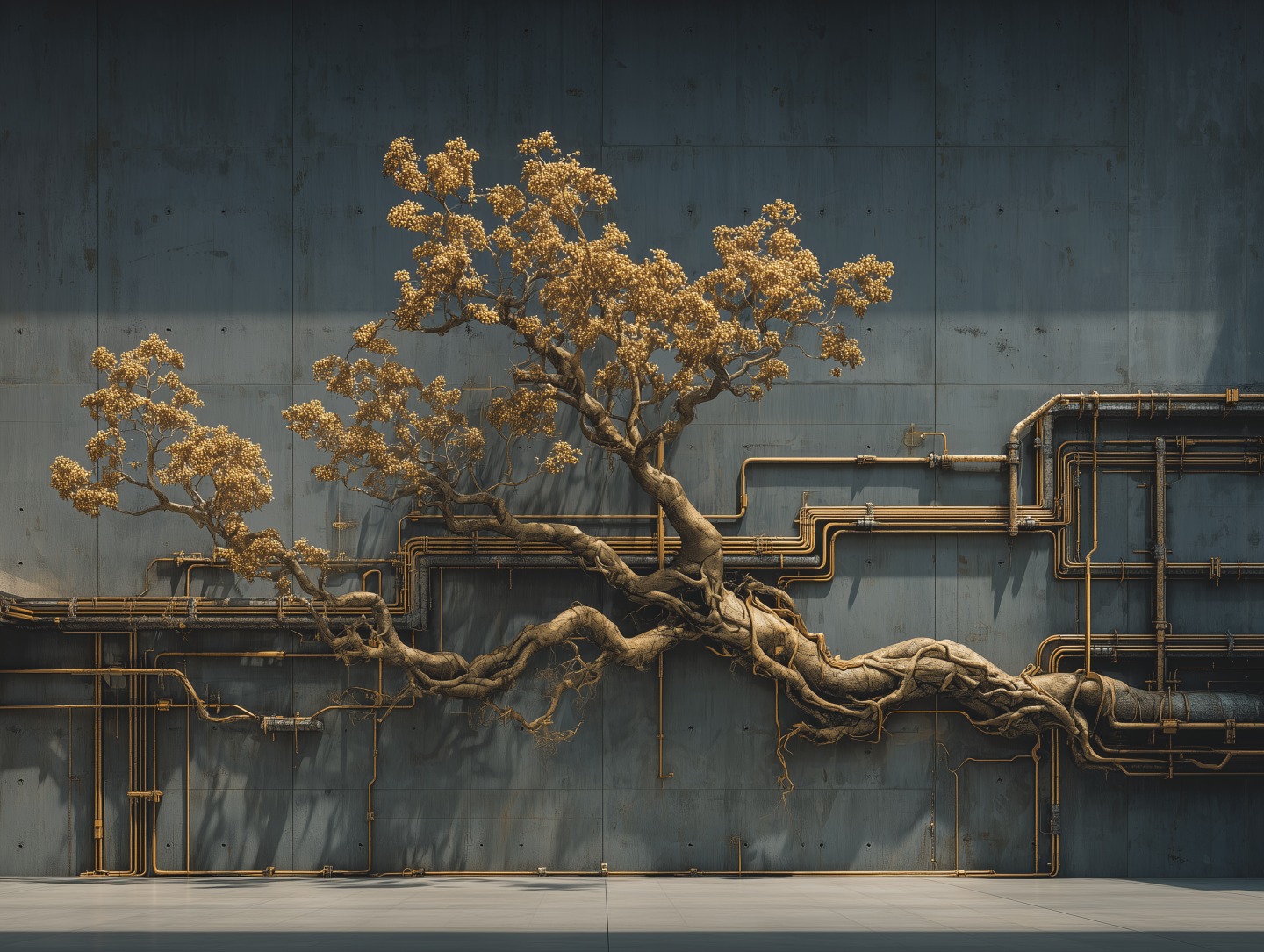
I work the way I learned to look at an image: through structure, tension, balance, and subtraction. I try to understand what is essential, what can disappear, and how a few well-placed rules can produce far more than they explicitly describe.
Over time, code, 3D, artificial intelligence, electronics, and mechanics have become different materials in the same work. I do not really think in disciplines, but in relationships, constraints, flows, and feedback loops. What interests me is less the tool than the organization it makes possible.
The living world has become a natural reference: not as a model to copy, but as proof that a complex whole can be distributed, autonomous, efficient, adaptable, and coherent without a center controlling everything. Richness then comes from the interaction between relatively simple mechanisms, from their history, and from their ability to change.
In the end, I build to test my intuitions. An architecture must remain clear enough to understand why it works, open enough to accept that it may fail, and free enough to sometimes produce an answer I did not write.

